Anna's Irish Crafty Corner

A Journey Through Crafts And Things I Like In Life; "From one fine thread a work of art is born" - DMC Motto; "To plant a garden is to believe in tomorrow" Audrey Hepburn; "The purpose of our lives is to be happy" Dalai Lama.

Followers

Monday, 4 August 2025

My Garden - August 2025


Dear Gentle Reader,

August has arrived and ready to reveal what it has in stored for the gardener. This year my garden, for many reasons didn't perform the way I would have liked, but still it has its own moments. The pears are getting bigger and bigger (don't ask me the type, wind blew away the lable, but I know one of my pear trees is Conference the other something else. Thus coukd be Conference, I'm not sure, though), my apple trees were full of flowers, though only one fruit is on the tree. This could be due to early blooming, not enough pollinators, wet spring, honestly, could be anything at all. Cobnuts never fail they just produce. Happy(ish) days.
Yesterday (the 11th) I had to harvest my grapes, they were so ripped that at the smallest shake would end up on the floor, which would be a shame. They are so sweet and juicy and amazingly beautiful bunches. 3.2 kilos not bad from a 5 year old grape vine. 
This was a bunch from my 1st pick, but I'm sure there are heavier bunches. It doesn't come fresher then this. Tomatoes and chilies are keep giving which is awesome.

Aubergines keep growing which is fabulous too 😜
I decided to try my luck with kiwis....yes, they can be grown in Ireland in a greenhouse, this perticular cultivar is called 'Jenny' and it's specifically bred for colder, Irish weather. More info here. So I got my kiwi plant, gorgeous looking, strong plant and planted it according to instructions in my small greenhouse, because I felt that that greenhouse it's really not used to the max. So, with a bit of luck I shall eat my own, home grown kiwi in about 3-4 years 🤷🤦. I live in hope. 😁😁. So continuing on, that's my huge crop of onions so far and cucumbers and part of my succulents and cactae enjoying the sauna conditions in my small greenhouse. 😜
Autumn raspberries are full of yummie, delicious, sweet fruit. And they'll be producing fruit until the 1st frost will turn them into frozen delights (don't ask me how I know this 😜😂). The beebalms are young plants and I think they are doing well so far. The succulents and cactae in my small greenhouse will join the others in the living room on the windowsill before the 1st frost. 
I feel like all the odds were a bit against me this year, nothing went they way I would have liked. However the little blessings are keep coming and I'm OK with that. I count my blessings every day and I give thanks to God that I can enjoy life with the people dear to my heart 😊❤️


1 comment:
Email ThisBlogThis!Share to XShare to FacebookShare to Pinterest
Labels: my garden

Tuesday, 8 July 2025

My Garden June - July 2025

Dear Gentle Reader,

Months came and go, and here we are 7 months into the year. These months went by flying, of course they would when one has fun. 
July is the seventh and current month of the year in the Julian and Gregorian calendars. Its length is 31 days. It was named by the Roman Senate in honour of Roman general and statesman Julius Caesar in 44 B.C., being the month of his birth. Before then it was called Quintilis, being the fifth month of the calendar that started with March. "Dog days" are considered to begin in early July in the Northern Hemisphere, when the hot sultry weather of summer usually starts. Spring lambs born in late winter or early spring are usually sold before 1 July. 
I never imagined harvesting such a big quantaty of strawberries from my young patch. I took out the old and replanted them with new plants bought and from what I had growing in the garden. They'll give me what I need for the table for the next 4-5 years 🍓😁😋
Oh I must brag... Did you see the huge crop of cherries??? Oh my gosh, I could barely carry them in the house 😂😍🍒however when I tasted them they were so sweet and juicy and the flesh was dark. Can't remember the type, but I think I'm one of the few who are lucky enough to grow such heat demanding fruit in the East Coast. Hey, at least I got to taste them 😜😋Pears look good, Conference I think, I'm going to have a few of them too. Bushes of currants, canes of raspberries are laden with fruit. And lord behold, I have 1 lonely plum on one of my plum trees. The other apples didn't do well, they bloom early when the pollinators were still sleeping, yet I will have 2 apples from my Honey Crisp apple tree.The yellow and red crabapples look good too.  Birds will be happy during winter. 
Yesterday (11th of July) I harvested some of my raspberries, and red currants. I'll juice them out along with some apples and oranges, it will be amazing :) Tomatoes, chilies, eggplants are coming along nicely too. Grapes look fab too. Look at those huge bunches.... Yummm :) 
Looking at my grapes I've noticed a few very young, still in bloom stage bunches... This way I might have grapesbwell into autumn 😜🍇my Callas are blooming too, so far yellow and dark reddish. Freshly picked raspberry duo for brekkie.... Breakfast doesn't come fresher then this ❤️
Bounty season continues in my little garden. 

That's all for this month. 
Enjoy your garden
Annamaria 


No comments:
Email ThisBlogThis!Share to XShare to FacebookShare to Pinterest
Labels: my garden

Christmas in July in the tatting world 2025

Dear Gentle Reader, 

Patterns belong to Wanda Salmans 

Christmas in July began in 1933 at Keystone Camp in Brevard, North Carolina, thanks to the whimsical spirit of camp co-founder Fannie Holt.
The camp’s celebration included carols, Santa, cotton snow, and creative gifts, making midsummer feel magical.
Christmas in July (as some people call it, Half Christmas) eventually became a beloved summertime escape, especially with Hallmark's snowy movie marathons it became so popular that you not have even thought about who first dreamed up such a cheery, potentially cheesy, midsummer celebration.
Besides on hot days like July it's always welcomed something "cold", like a few flurries to cool self down. The first Christmas in July included carolers, a Christmas tree, Santa Claus, presents, and fake snow made of cotton. As the tradition evolved, campers would use laundry bags as makeshift stockings, which they placed outside their cabins to be filled with candy overnight. Eventually, elves, reindeer, and Mrs. Claus joined the act, along with a camp-wide gift exchange. 

To bring a little Christmas in July spirit in your homes The Online Tatting Class group thought to start off with Wanda's lovely patterns. You can find these on the group's website, link here and YouTube channel link here. Being a member and studeent of this awesome group it's a real priviladge. Every single time we have classes I learn something new. We also have laughter and stories are shared. But mostly and this is VERY IMPORTANT, every single student is learning how to tat in a safe and friendly inviroment, where the teacher encourages her  students to thrive and embrace this wonderful lace creating craft. 

Happy Tatting and 
All the best
Annamaria 


No comments:
Email ThisBlogThis!Share to XShare to FacebookShare to Pinterest
Labels: Tatting

Tatting, in a nutshell 2025

Dear Gentle Reader 

What is tatting? you may ask... So here is me putting all the answers in a little nutshell for you....

Tatting is a type of lacemaking that involves creating intricate patterns with knots and loops using a shuttle and thread or needle and thread. It's a delicate craft, often used to make edgings, doilies, or even jewelry. While its exact origins are unclear, tatting is thought to have evolved from knotting techniques and gained popularity in the 19th century with the availability of finer threads. 

Here's a more detailed look:

What it is: Tatting is a lacemaking technique that uses a shuttles or needles to create knots and loops, forming a variety of decorative patterns. 

How it's done: A tatting shuttle holds the thread, which is manipulated to create double stitches that form rings and chains, formed from a series of cow hitch or half-hitch knots, called double stitches, over a core thread. Gaps can be left between the stitches to form picots, which are used for practical construction as well as decorative effect.
In German, tatting is usually known by the Italian-derived word Occhi or as Schiffchenarbeit, which means "work of the little boat", referring to the boat-shaped shuttle; in Italian, tatting is called chiacchierino, which means "chatty".
The earliest evidence for needle tatting dates from April 1917, in an article by M.E. Rozella, published in The Modern Priscilla.[5] A tatting needle is a long, blunt needle that does not change thickness at the eye of the needle. The needle used must match the thickness of the thread chosen for the project. Rather than winding the shuttle, the needle is threaded with a length of thread. To work with a second color, a second needle is used. Although needle tatting looks similar to shuttle tatting, it differs in structure and is slightly thicker and looser because both the needle and the thread must pass through the stitches. However, it may be seen that the Victorian tatting pin would function as a tatting needle. As well, Florence Hartley refers in The Ladies' Hand Book of Fancy and Ornamental Work (1859) to the use of the tatting needle, so it must have originated prior to the mid-1800s.

In the late 20th century, tatting needles became commercially available in a variety of sizes, from fingering yarn (s sock yarn or thin wool yarn used for embroidery) down to size 80 tatting thread. Few patterns are written specifically for needle tatting; some shuttle tatting patterns may be used without modification.

Materials: Tatting typically uses a specialized shuttle and thread, often a fine cotton thread, though other materials can be used. A small crochet hook or needle is sometimes used to help with joining picots or working with finer threads. Older designs, especially through the early 1900s, tend to use fine white or ivory thread (50 to 100 widths to the inch) and intricate designs. Often they were constructed of small pieces 10 cm or less in diameter, which were then tied to each other to form a larger piece — a shawl, veil or umbrella, for example. This thread was either made of silk or a silk blend, to allow for improper stitches to be easily removed. The mercerization process strengthened cotton threads and spread their use in tatting. Newer designs from the 1920s and onward often use thicker thread in one or more colors, as well as newer joining methods, to reduce the number of thread ends to be hidden. The best thread for tatting is a "hard" thread that does not untwist readily. Cordonnet thread is a common tatting thread; Perl cotton is an example of a beautiful cord that is nonetheless a bit loose for tatting purposes. Some tatting designs incorporate ribbons and beads.

History: While some believe tatting evolved from knotting techniques used centuries ago, the form we recognize today emerged in the 19th century. The first published article in 1851 on how to join Picots with a crochet hook greatly speeded up the work.. 1864 saw the arrival of the second shuttle or Ball Thread, which was used for working a chain. This was attributed to Eleanor Riego. 
In "The Crochet Book, Fourth Series," Eléonore Riego de la Branchardière exemplifies an innovative approach to crochet, blending exquisite technical detail with an artistic flair. The book serves as a comprehensive guide, showcasing patterns that range from the intricate to the accessible, reflecting the Victorian era's fascination with domestic arts. Riego de la Branchardière's prose is imbued with a conversational yet authoritative tone, allowing both novices and skilled artisans to engage deeply with the craft. The volume not only presents a collection of patterns but also contextualizes crochet within the broader tapestry of 19th-century fiber arts, inspiring readers to appreciate the social and aesthetic dimensions of their work. As an influential figure in the realm of needlework literature, Riego de la Branchardière draws from her own extensive experience in textile arts, as well as the aesthetic movements surrounding her. Her passion for crochet is evident in the meticulous instruction and evocative illustrations that characterize this series. Through her work, she both preserves and innovates traditional techniques, appealing to a generation eager for both guidance and inspiration. Recommended for both aspiring crafters and seasoned practitioners, "The Crochet Book, Fourth Series" is a treasure trove of creativity that invites readers to explore their artistic talents. With its rich historical context and practical guidance, this book stands as an essential resource, advocating  was a luminary in the nineteenth-century needlework revival, a period which saw an explosion of interest in crafts and domestic arts. Known particularly for her pioneering work in crochet, Riego de la Branchardière is credited with popularizing the lace-like crochet technique known as 'Irish crochet,' which emulated fine Venetian point laces. Her manual 'The Crochet Book, Fourth Series' is one of the many she authored, contributing significantly to the Victorian craft movement. Throughout her works, Eléonore emphasized precision, creativity, and the educational value of needlework. Her books provided clear instructions and patterns that were accessible to a wide audience, enabling the refinement of skills in the comfort of one's home. Not only are her publications of historical interest, but they remain valuable resources to present-day crafters seeking to explore traditional techniques. Riego de la Branchardière's literary style is characterized by its didactic tone and attention to detail, reflecting her dedication to imparting her mastery to others. Though definitive biographical details are sparse, her literary output testifies to an enduring legacy in the fields of crochet and handicrafts, signaling her as a paragon of the Victorian craft movement.
Tatting may have developed from netting and decorative ropework as sailors and fishermen would put together motifs for girlfriends and wives at home. Decorative ropework employed on ships includes techniques (esp. coxcombing) that show striking similarity with tatting. 
Some believe tatting originated over 200 years ago, often citing shuttles seen in 18th-century paintings of women such as Charlotte of Mecklenburg-Strelitz, Princess Marie Adélaïde of France, and Anne, Countess of Albemarle. A close inspection of those paintings, however, shows that the shuttles in question are too large to be tatting shuttles, and that they are actually knotting shuttles. There is no documentation of or examples of tatted lace that dates prior to 1800. All available evidence shows that tatting originated in the early 19th century. However, recent research by Cary Karp demonstrates some potential connections between the two fiber arts. According to Karp, "Knotting and tatting did appear sequentially in the historical record and can reasonably be regarded separately...the demarcation between the structures that characterise knotting, and the central elements of tatting, was not as clear cut as is often maintained."
As most fashion magazines and home economics magazines from the first half of the 20th century attest, tatting had a substantial following. When fashion included feminine touches such as lace collars and cuffs, and inexpensive yet nice baby shower gifts were needed, this creative art flourished. As the fashion moved to a more modern look and technology made lace an easy and inexpensive commodity to purchase, hand-made lace began to decline. Tatting has been used in occupational therapy to keep convalescent patients' hands and minds active during recovery, as documented, for example, in Betty MacDonald's The Plague & I.
And here's a bit of history that involves my 2nd hometown 

Uses: Tatting is used to create a wide range of items, including edgings for linens, doilies, collars, and jewelry like earrings, necklaces, brooches, bracelets, baby stuff, wedding stuff etc. Tatting is fun, it takes us a very small space in your bag, pocket (if you are carrying your shuttles with you, you cant do that with your needles), doesn't require a ton of supplies (shuttle, ball of thread, crochet hook and scissors), it's also the least expensive of all crafts. 

Distinction from Crochet: While both are forms of lacemaking, crochet uses a hook to create loops and stitches, while tatting uses knots and a shuttle. Tatting also tends to produce more durable and intricate lace. 
Bit more about tatting here

Resources: 
- Wikipedia 
- Guild of Irish Lace Makers 
    Www.irishlaceguild.com
- www.britannica.com
- Pam Palmer: Tatting (permission to use the page from her Mom's book was given to me by her daughter Sarah Baldock) 

3 comments:
Email ThisBlogThis!Share to XShare to FacebookShare to Pinterest
Labels: Tatting

Friday, 4 July 2025

The useful tatting journal 2025

Dear Gentle Reader, 

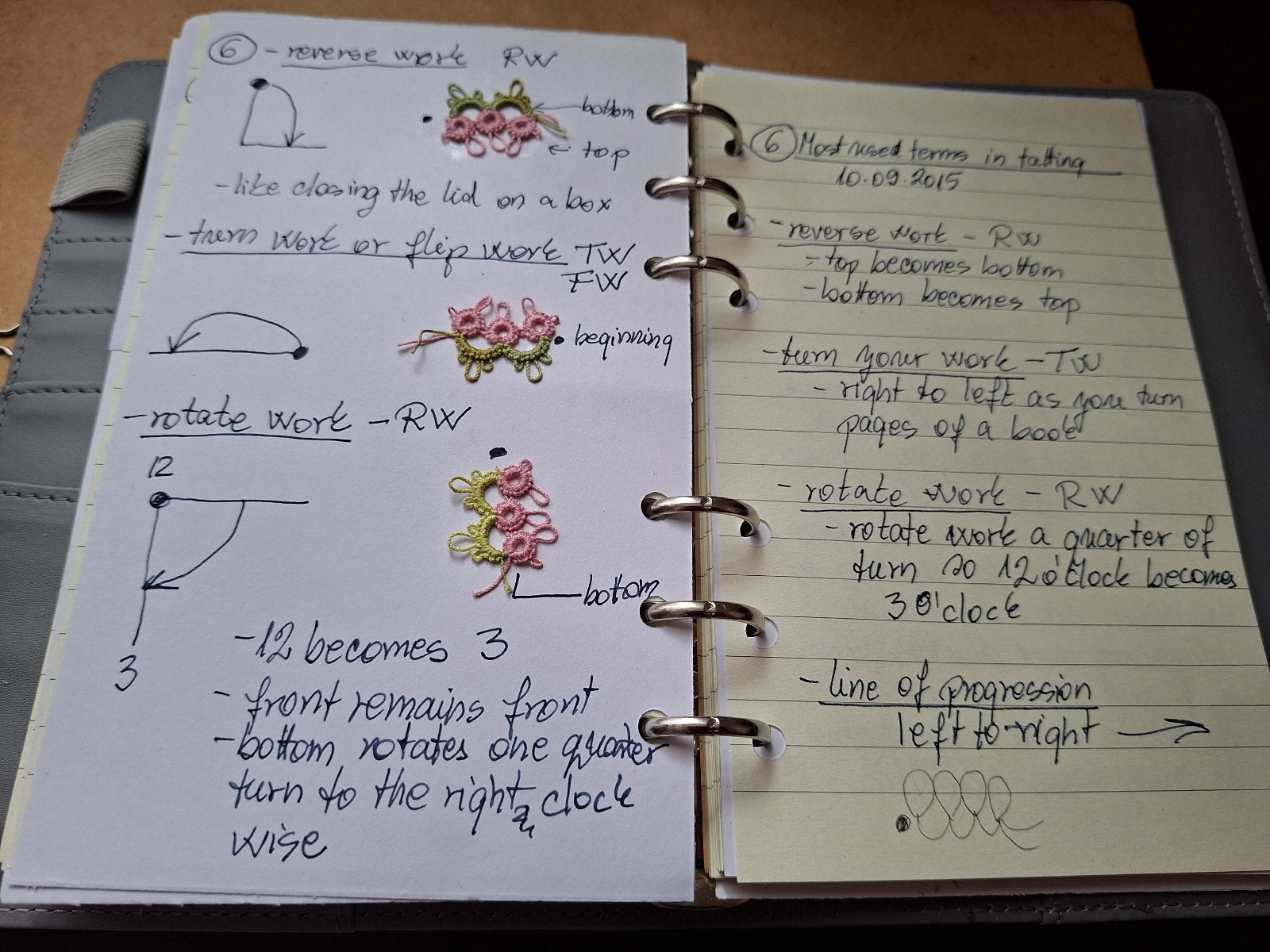
A tatting journal is a notebook specifically designed for documenting tatting projects, techniques. It typically includes space for recording information about the pattern, materials used, and the finished piece, along with photos and samples. This allows tatters to keep track of their work, revisit successful patterns, and avoid repeating unsuccessful ones, while also noting who received their creations. 


My tatting journal {created in 2020 (when I started tatting more seriously and signed up for classes) up to this day} serves as a sample book too and I also keep record of my good threads, that are nicely tucked in the drawers of my storage unit. Every drawer contains a size. I have threads from size 10 up to size 80, these are Lizbeth, cotton threads. This high quality thread is shiny and has a rich and vibrant color. It is super-combed, gas-singed for outstanding body, mercerized, and colorfast. The thread is made with a natural fiber. It's a bit twisty (it's only flaw), however a tatter learns a few tricks of the trade to reduce this twist 😜😁. 
My new discovery are polystyrene threads called C-lon, they are micro cords and they tat up beautifully, especially jewellery. C-lon thread is nylon and you'd need a burner for a clean finish to avoid unravelling. It's strong, thin, waterproof. A dear friend of mine (who is also my tatting teacher 😜) introduced them to me for which I'm eternally grateful. 


Of course there are a rake if other threads besides Lizbeth on the market, but these are my favored ones. 

Here's a more detailed breakdown: 
Purpose:
A tatting journal helps crafters organize their tatting projects, track their progress, and document their creative journey.
Content:
These journals usually include dedicated sections for:
Project Details: Pattern name, designer, materials (thread type, color, quantity), date started/finished.
Notes: Space for jotting down notes on the pattern, any modifications made, or tips for future projects.
Photos: Many journals include space to attach photos or swatches of the finished piece, allowing for visual reference.
Gift Giving: Some journals have sections to record who received the finished piece and their reactions.
Benefits:
By using a tatting journal, crafters can:
Stay Organized: Easily find and reference past projects.
Improve Skills: Learn from past successes and mistakes.
Avoid Duplicates: Keep track of gifts to avoid giving the same item to the same person.
Track Progress: See how their tatting skills have developed over time.
These later information were obtained through Google. 😁😎😜

If you, dear reader, you're a tatter and you'd like to make such a notebook, I shall leave here the link  where my teacher speaks about this useful lil notebooks. Link here 

You can have separate tatting journals, one for shuttle tatting, one for needle tatting, and for samples OR you can make something like I did all-in-one tatting journal. For me this is the best way, because this small notebook, I can pop in my bag with a few patterns, or a tatting book and off I go, I can tat anywhere, anytime 😜📖😁🪡🧶➰➿🧵

All the best,
Happy tatting
Annamaria


No comments:
Email ThisBlogThis!Share to XShare to FacebookShare to Pinterest
Labels: Tatting

Thursday, 19 June 2025

Treasures 2025

Dear Gentle Reader, 

Everyone passing through life gathers treasures, may it be in form of memories, or some sort of valuables or just trinkets that have a sentimental value attached to them. 
My treasures are linked with the crafts I'm doing and most recently with tatting. This is my 1st "professional" Tatting shuttle I bought, I shall treasure this
This is a Banyek shuttle (Etsy), Banyek László makes the most amazing wooden shuttles ever. They fit in your hands perfectly, they are light, and if you have arthritis in your hands, the wood will absorb your pain (any wood shuttle for that mater). I've heard this from a friend. 
A dear friend gifted me 2 wooden shuttles among a few  things. I will treasure them till the day I die. But those 2 shuttles really made my day. 😁 When I held those shuttles I really felt a warmth coming from them feeling, boosting my own creative energy. I shall create beautiful lace with them. 😁🧵🧶➿🪡 I already have them full of thread, making beautiful lace. 
Also 2 of my doodles went into my treasure box: Doodle-Duck and Doodle-Bun 
I'm so proud of these cutsies, these 2 were born while I was working on something else. It's amazing how many doodles are born, just like that through playing with thread. 
Aren't these the most beautiful, teeniny shuttle charms you have ever seen???!!!! I think they are. I've managed to purchase the last one on Etsy, I'm hoping the seller will have more in the future. This charm will adorn my charm bracelet, but until then I shall keep it safe in my treasure box 😜❤️
I added to my treasures Doodle Daff, this little motif was Cro-tatted with 1.5 mm cro-tatting tool. A happy accident turned it into this cutsie thing. 

I got another treasure just after Christmas, a personalised one from Banyek Shuttles 
Finally I own 2 shuttles that bears my small business's name.... Yayyyy :) 
So these are the treasures I gathered in 2025. But there is still more space in my treasure box that needs filling with special items. 

All the best, happy tatting
Anna


1 comment:
Email ThisBlogThis!Share to XShare to FacebookShare to Pinterest
Labels: miscellaneous

Monday, 19 May 2025

Tatting Jewelery - Corina Meyfeldt Earrings 2025

Dear Gentle Reader, 

Tatting is one of the oldest forms of lace making. It can come in many different shapes and forms. Jewellery is one of those tatted articles that are loved by everyone. Who doesn't love dainty, lacy, beaded jewelry? Right??!! ..... Right!!!! 😜😁

All through my tatting adventures (and through the tatting classes I'm signed up for 😜) I came across 2 super cute tatted earring patterns. Grew to love them both. These cute patterns belong to the wonderful tatter and designer called Corina Meyfeldt. She has lots of amazing patterns. 
On her blog Corina says about the "Wave" that  "the pattern is simple, so simple that is is boring. But do not rush while working it. Simple things can punish pretty hard the impatient hand." and goodness me, she was right. Blink and ops Murphy steps in and ruins your project 😜

There's another of her pattern's called "Simple RoR Earrings".  I just adore these 2 patterns. I made loads of each , different colors, different beads. I love these 2 patterns, I can see myself making even more of each one😜

Both are made of rings, there are certain types of joins, and delicious beads and only 1 shuttle or 1 needle.  Both contain techniques that can be challenging, but not impossible to do nor complicated, with a little bit of practice they are all doable. Just remember Corina's words and have as much fun tatting these as I am having. 

Both patterns can be found on her blog here. or on The Online Tatting Class website pattern collection  here and here. , or on The Online Tatting Class YouTube channel here and here.

All the best, 
Happy Tatting 
Annamaria 

3 comments:
Email ThisBlogThis!Share to XShare to FacebookShare to Pinterest
Labels: Tatting
Newer Posts Older Posts Home
Subscribe to: Posts (Atom)

My Garden - January 2026

Dear Gentle Reader, Happy New Year to you all.  I hope this post will find you all in good health, happy among your loved ones.  Today Winte...

  • Dissapointment, is not the word....
    Dear Gentle Reader I don't even know how to start this blog post so I'll start it as thoughts pop up in my head. This blog post also...
  • Tatting, in a nutshell 2025
    Dear Gentle Reader  What is tatting? you may ask... So here is me putting all the answers in a little nutshell for you.... Tatting is a type...
  • Nature In My Garden
    Hello, Since early spring wildlife have been visiting my garden. Now it's July and  birds, insects, butterflies, bees are still  enjoyin...

Search This Blog

  • Home
  • Tatting
  • My Garden

Report Abuse

Labels

  • garden
  • Macrame
  • miscellaneous
  • my garden
  • new
  • Resin
  • Tatting
  • The way I do it
  • welcome

Blog Archive

  • ▼  2026 (1)
    • ▼  January 2026 (1)
      • My Garden - January 2026
  • ►  2025 (22)
    • ►  December 2025 (1)
    • ►  November 2025 (2)
    • ►  October 2025 (2)
    • ►  September 2025 (3)
    • ►  August 2025 (5)
    • ►  July 2025 (4)
    • ►  June 2025 (1)
    • ►  May 2025 (2)
    • ►  April 2025 (1)
    • ►  January 2025 (1)
  • ►  2024 (21)
    • ►  November 2024 (1)
    • ►  September 2024 (2)
    • ►  August 2024 (2)
    • ►  July 2024 (2)
    • ►  June 2024 (3)
    • ►  May 2024 (2)
    • ►  April 2024 (3)
    • ►  March 2024 (3)
    • ►  February 2024 (2)
    • ►  January 2024 (1)
  • ►  2023 (15)
    • ►  November 2023 (1)
    • ►  October 2023 (2)
    • ►  September 2023 (2)
    • ►  August 2023 (4)
    • ►  July 2023 (6)

About Me

My photo
Anna
View my complete profile
Picture Window theme. Powered by Blogger.